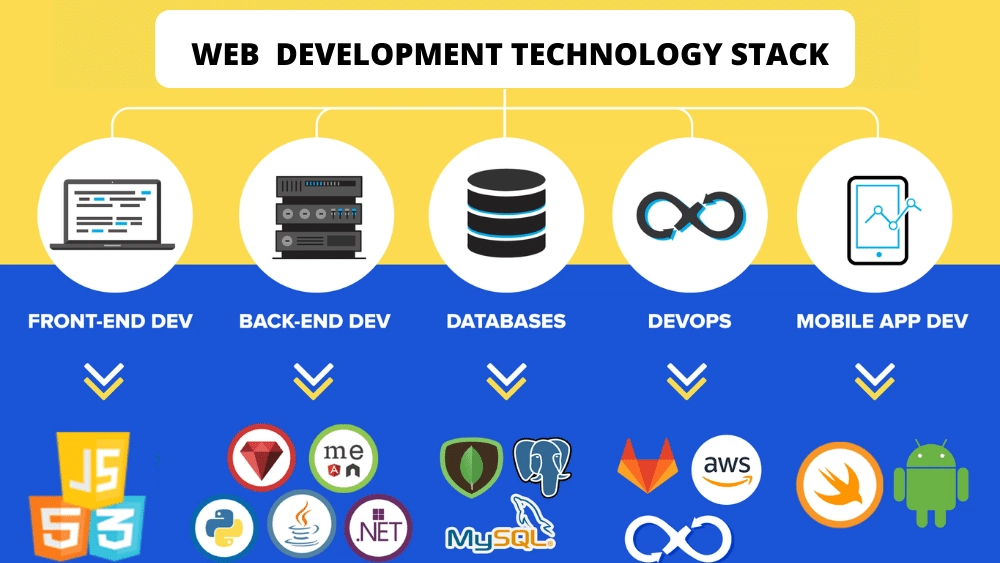
Modern web development has evolved far beyond simple HTML pages. Today’s applications are dynamic, scalable, and performance driven, which is why developers rely on structured web development stacks. The web development stacks are collection of technologies used together to build a complete web application, covering frontend, backend, database, and deployment.
Among the most popular modern stacks are MERN, MEAN, and JAMstack. Each stack serves different project requirements and offers unique advantages. Understanding these web development stacks is essential for developers who want to build efficient applications and stay competitive in the tech industry.
Table of Contents
What Is a Web Development Stacks
A web development stack refers to a combination of programming languages, frameworks, libraries, and tools used to create a web application from start to finish. It typically includes frontend technologies for user interfaces, backend technologies for server logic, databases for data storage, and additional tools for deployment and performance.
Choosing the right stack impacts application scalability, performance, security, and long term maintenance. That is why modern developers carefully evaluate web development stacks before starting a project.
The MERN Stack Explained
What Does MERN Stand For
MERN is an acronym for MongoDB, Express.js, React, and Node.js. It is one of the most popular full stack JavaScript solutions used for building dynamic and scalable web applications.
The biggest advantage of MERN is that it uses JavaScript across the entire application, from frontend to backend, making development faster and more consistent.
How the MERN Stack Works
In the MERN stack, MongoDB is used as a NoSQL database to store application data. Express.js runs on top of Node.js to handle server side logic and APIs. On the frontend, React is used to build interactive and component based user interfaces.
This architecture allows developers to build fast, real time applications such as dashboards, social media platforms, and SaaS products.
When to Use the MERN Stack
MERN is ideal for applications that require high interactivity, real time updates, and scalable architectures. It is widely used by startups and enterprises due to its flexibility and strong community support.
The MEAN Stack Explained
What Does MEAN Stand For
MEAN stands for MongoDB, Express.js, Angular, and Node.js. Like MERN, it is a full stack JavaScript solution, but it uses Angular instead of React for frontend development.
MEAN is often preferred for enterprise level applications that require structured architecture and long term maintainability.
How the MEAN Stack Works
The MEAN stack uses MongoDB for database management, Express.js and Node.js for backend processing, and Angular for frontend development.
Angular is a full featured framework that includes built in tools for routing, form handling, and state management, making it suitable for large scale applications.
When to Use the MEAN Stack
MEAN is best suited for complex enterprise applications where consistency, scalability, and long term support are critical. Companies that prefer opinionated frameworks often choose MEAN for its structured development approach.
What Is JAMstack
Understanding JAMstack Architecture
JAMstack stands for JavaScript, APIs, and Markup. Unlike MERN and MEAN, JAMstack is not a traditional server based stack. Instead, it focuses on delivering pre rendered content and consuming APIs to create fast and secure web applications.
JAMstack sites are often deployed on Content Delivery Networks, which significantly improves performance and security.
How JAMstack Works
In JAMstack architecture, markup is pre built using static site generators, JavaScript handles dynamic functionality, and APIs manage backend services. Popular tools used in JAMstack development include Next.js, Gatsby, and Netlify.
This approach reduces server dependency and enhances scalability, making JAMstack ideal for modern websites.
When to Use JAMstack
JAMstack is perfect for blogs, marketing websites, documentation sites, and e commerce platforms where speed, SEO, and security are priorities.
MERN vs MEAN vs JAMstack
Performance and Scalability
JAMstack offers the best performance due to pre rendered content and CDN delivery. MERN and MEAN provide excellent scalability for dynamic applications but rely more on server processing.
Development Complexity
MERN offers flexibility and faster development cycles, while MEAN provides a more structured approach. JAMstack simplifies deployment but requires API based thinking.
SEO and Security
JAMstack excels in SEO and security because it minimizes server side vulnerabilities. MERN and MEAN can also be SEO friendly when optimized correctly using modern rendering techniques.
Which Stack Should You Choose
Choosing the right stack depends on your project requirements and career goals. If you want to build full stack JavaScript applications with real time features, MERN is an excellent choice. If you prefer enterprise level applications with strong structure, MEAN is more suitable. For performance focused and SEO friendly websites, JAMstack is the best option.
According to insights from the Stack Overflow Developer Survey, JavaScript based web development stacks continue to dominate modern web development, making these web development stacks highly valuable for developers.
Final Thoughts
Modern web development stacks play a crucial role in building fast, scalable, and secure applications. MERN, MEAN, and JAMstack each offer unique advantages depending on project needs. Understanding these web development stacks not only improves your technical skills but also helps you make better architectural decisions.
Also Check Frontend vs Backend Development – Comprehensive Guide 2026
1 thought on “Modern Web Development Stacks – Comprehensive Guide – 2026”